
FAQs
The questions worth asking before you commit
Costs, timescales, materials, disruption, guarantees. No hedging.
Everything below is the answer Ollie would give you on the phone. If your question is not here, ring him — it is a quick conversation and there is no sales pitch attached.
Cost & value
Most complete kitchens fall between roughly £12,000 and £35,000 for cabinetry, painting and fitting, with worktops and appliances on top. A compact galley in a flat sits at the lower end. A large in-frame kitchen with an island, a pantry and solid oak surfaces sits at the upper end.
Because there is no showroom, no sales commission and no head office, more of what you pay ends up in the timber and the hours.
Compared with entry-level trade kitchens, yes. Compared with the mid and upper ranges of the well-known retailers — once you have added the doors you actually wanted, the soft-close everything and the fitting — it is often close, and occasionally less.
The real difference is in what happens at year ten. A chipboard carcass with cam-lock fixings is a consumable. A biscuit-jointed cabinet with dovetailed drawers can be repainted and carry on.
Yes — see finance options. Payment is also staged so you are never far ahead of the work: a deposit to secure the slot and buy materials, a stage payment when making starts, and the balance on completion.
No. The first visit, the measure and the drawings are free, and there is no obligation. Ollie would rather find out early that a project is not a fit than talk anybody into one.
Design & making
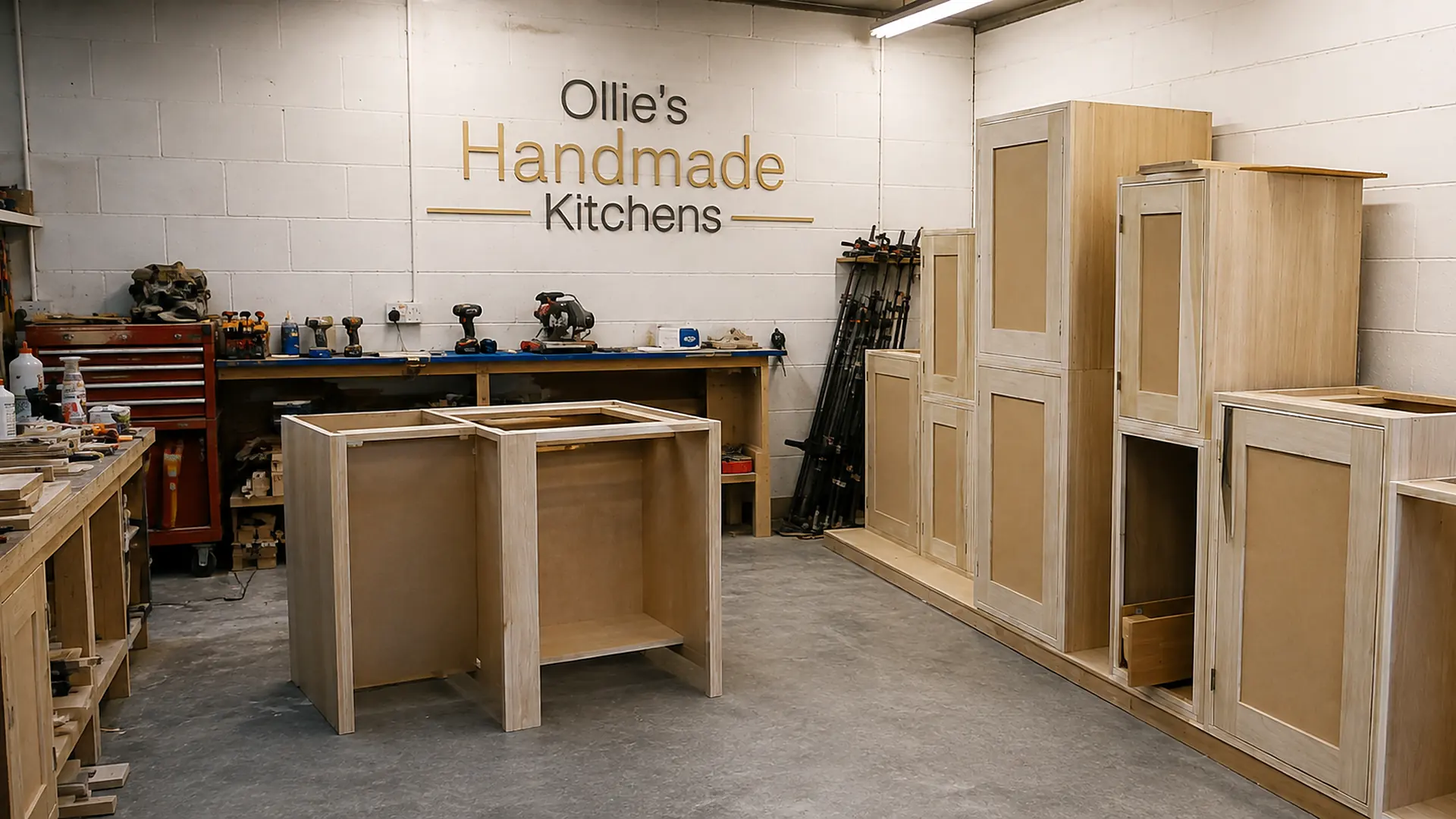
Every carcass is cut and biscuit-jointed by Ollie. Every door frame is machined from solid tulipwood or oak. Every drawer box is dovetailed. Nothing arrives flat-packed and nothing is drilled by a machine in another country. The only bought-in components are hardware, worktop stone if you choose it, and appliances.
Usually, and often improve it for your room. Bring photographs, screenshots, a Pinterest board, a page torn out of a magazine — anything. Because nothing is catalogue-based, matching a look is a question of door proportion, moulding profile and colour rather than whether a range exists.
It is the reason to go bespoke. Sloping ceilings, chimney breasts, boxed-in soil pipes, floors that fall across the room, Victorian returns two metres wide — these are the situations where standard cabinet widths force ugly compromises and filler panels. A made-to-measure kitchen simply absorbs them.
You get scaled plans and elevations, which is what actually gets built from. Ollie is a carpenter rather than a CGI studio, and would rather spend the time on the joinery than on a photorealistic render of a kitchen that does not exist yet.
Timings & disruption
Typically eight to ten weeks in total: a week or so for drawings and a quote, three to six weeks making, one to two weeks fitting, then painting and handover. You will have dates before anything is ordered.
Usually one to two weeks. Your old kitchen stays in use for the whole making period. During the fit, Ollie will keep the sink and an appliance running for as long as physically possible and will tell you in advance which days will be difficult.
Dust sheets go down, doorways get sealed where it matters, and the site is swept every evening before he leaves. It is still building work, but you should not be finding sawdust in the bedroom.
Practical & aftercare
Two years on every kitchen. If any element fails in that time, Ollie comes back and fixes it free of charge. Hardware such as hinges and runners often carries a longer manufacturer's guarantee on top.
Yes — £1m public liability cover for the entire time work is being carried out at your property.
Ollie does all the carpentry himself and coordinates the other trades around it, using people he works with regularly. Stone and quartz worktops are templated and fitted by specialists. If you would rather use your own trades, that is completely fine.
Yes, if the carcasses are sound — it is a legitimate way to transform a kitchen for a fraction of a full replacement. If the boxes are already swelling at the base or the cam locks have chewed out, Ollie will tell you it is money badly spent.
A damp cloth and mild soap, and avoid anything abrasive or solvent-based. The advantage of a brushed on-site finish is that it can be touched in or fully repainted years later without replacing a single cabinet. Ollie will leave you the paint codes.
Regularly in East Sussex, Surrey and Hampshire, and further afield for the right project. Ask — the honest answer depends on the size of the job and the time of year.
Next step
Still got a question?
Ring Ollie directly. He answers his own phone, and if he is on the tools he will call you back the same day.